

What is a Field Service Management (FSM) Platform? A Comprehensive Guide for Contractor Companies in 2026
In the fast-paced world of construction and property management, where contractor companies juggle multiple sites, teams, and client expectations, efficiency isn’t just a goal: it’s a necessity. In fact, the right tools can transform chaotic operations into streamlined successes. Enter Field Service Management (FSM) platforms: software solutions designed to coordinate and optimize the activities of mobile workers performing tasks outside the main office or facility. These platforms handle everything from scheduling and dispatching technicians to managing inventory, tracking work orders, and ensuring seamless client communication.
At its core, FSM software bridges the gap between back-office administration and on-site execution. It enables contractor teams (whether large or small, specialized or generalist), to dispatch the right team member to the right job with the necessary tools and information. Key components include real-time scheduling to avoid conflicts, GPS tracking for efficient routing, work order management for task tracking, invoicing automation, and analytics dashboards for performance insights. For contractors working on multi-lot or multi-tenant projects like subdivisions, condos, or commercial developments, FSM platforms model properties, lots, and units to align with contract structures, providing full traceability across jobs, estimates, and invoices.
Why does this matter in 2026? With the global FSM market projected to reach $9.68 billion by 2030, growing at a CAGR of over 11%, these tools are essential for staying competitive. They not only boost operational reliability but also enhance client visibility and satisfaction, turning one-off jobs into long-term partnerships.
The Proven Benefits of Using an FSM Platform: Statistics and Real-World Impact
Adopting an FSM platform isn’t just about going digital; it’s about driving measurable improvements in efficiency, productivity, and profitability. Based on industry data from 2025-2026, businesses using FSM software report significant gains across key metrics.
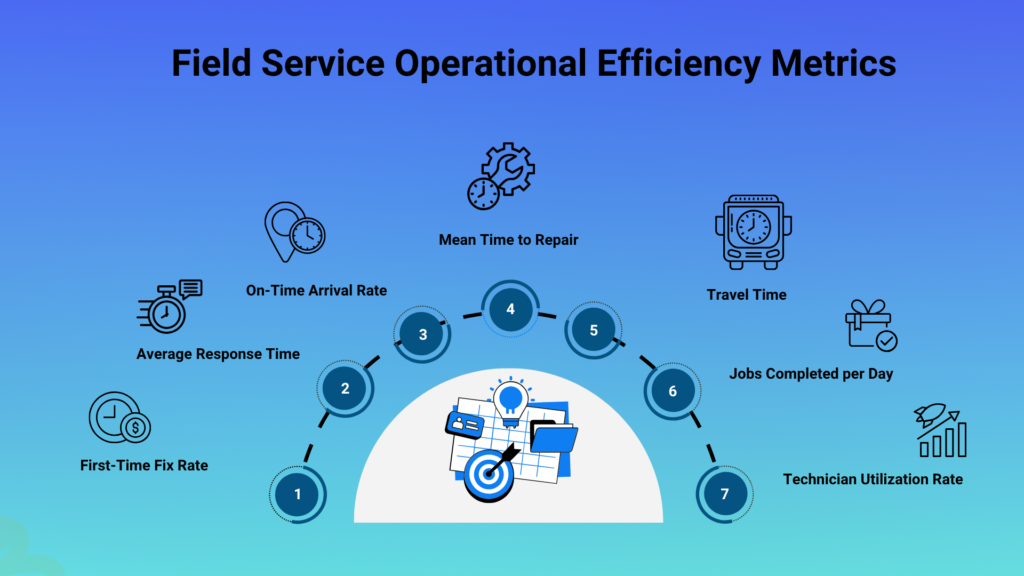
For starters, operational efficiency sees a massive uplift. Companies implementing FSM tools experience up to a 30% reduction in unplanned downtime through predictive maintenance powered by IoT sensors and AI. This is crucial for contractors managing multi-site projects, where delays can cascade across lots and erode profit margins. Technician productivity jumps by 20-40% with features like automated scheduling, route optimization, and mobile access to job details, allowing more jobs per day and less time wasted on travel or paperwork.
Cost savings are another major draw. FSM software reduces operational expenses by 20-35%, including lower fuel costs from smarter routing, decreased overtime through better planning, and minimized errors in billing and inventory management. For example, in high-traffic areas like Toronto, avoiding rush-hour scheduling can save 139 hours per vehicle annually, cutting fuel and emissions while boosting job completion rates. Overall, organizations report a 33% increase in technician productivity and a 35% drop in drive time, directly translating to higher revenue opportunities.
Customer satisfaction also soars. With FSM, first-time fix rates improve by over 20%, as technicians arrive prepared with the right parts and history. This leads to 88% of users noting better customer experiences and higher retention. In construction and property management, where developers demand transparency across portfolios, FSM platforms provide client portals for real-time updates, fostering trust and repeat business.
These benefits aren’t hypothetical: they’re backed by widespread adoption. A staggering 93% of service organizations have integrated AI into FSM for enhanced uptime and efficiency. For contractors specializing in multi-tenant setups, like those partnering with builders on apartments or mixed-use sites, FSM ensures compliance, reduces wastage, and scales with project evolution.
Landscape Overview: Top FSM Platforms in 2026 and What Sets Them Apart
The FSM market in 2026 is diverse, with platforms catering to everything from small trades businesses to enterprise-level operations. Here’s a curated overview of the top FSM platforms, based on reviews, features, and differentiators from sources like Gartner Peer Insights and industry comparisons. Pricing is subscription-based, typically per user/month, with annual commitments offering discounts.
1. Salesforce Field Service
- Overview: A robust, cloud-based FSM integrated with Salesforce CRM, ideal for large-scale operations. It excels in AI-driven scheduling, predictive maintenance, and customer engagement.
- Differentiators: Strong in analytics and IoT integration, with mobile apps for offline access. However, it requires familiarity with the Salesforce ecosystem, making it less plug-and-play.
- Pricing: Starts at $25/user/month for basics, up to $165/user/month for premium features (annual billing).
- Best For: Enterprises with complex client portfolios needing deep CRM ties.
2. Microsoft Dynamics 365 Field Service
- Overview: AI-powered platform with strong ERP/CRM integrations, focusing on predictive analytics, work order management, and asset tracking.
- Differentiators: Superior for preventive maintenance and scalability, with mixed reality tools for remote troubleshooting. It’s workflow-heavy, which can be a learning curve for smaller teams.
- Pricing: Around $95/user/month, with enterprise plans custom-quoted.
- Best For: Mid-to-large contractors in multi-site projects requiring full automation.
3. ServiceTitan
- Overview: Tailored for home services like HVAC and plumbing, with end-to-end management from estimates to payments.
- Differentiators: Excellent for marketing and customer retention, with built-in call booking. It shines in trades but lacks deep customization for unique workflows.
- Pricing: $250-$400 per technician/month, often bundled for teams.
- Best For: Trade-specific contractors focused on customer acquisition.
4. Jobber
- Overview: User-friendly for small to mid-sized businesses, covering scheduling, invoicing, and client communication.
- Differentiators: Intuitive interface with quick setup; great for multi-industry services. Limited AI compared to enterprise options.
- Pricing: From $169/month for up to 5 users (Core plan), scaling to custom for enterprises.
- Best For: Small contractors needing straightforward tools.
5. SAP Field Service Management
- Overview: Enterprise-grade with strong reporting and contract management, integrated with SAP ecosystems.
- Differentiators: Excels in compliance and global operations; robust for data sharing but can be complex to implement.
- Pricing: Custom, often $100-$450/month based on scale.
- Best For: Large developers with international portfolios.
6. Housecall Pro
- Overview: All-in-one for home services, emphasizing ease of use with dispatching and payments.
- Differentiators: Affordable with strong mobile features; best for quick invoicing but less customizable for multi-lot complexities.
- Pricing: $59-$329/month depending on plan (up to 5 users in mid-tier).
- Best For: Small business owners in residential trades.
7. Jetmir
- Overview: A hyper-customizable FSM platform built for contractors in multi-lot/multi-tenant residential and commercial projects, like subdivisions and apartments. It models properties, lots, and units to match contract structures, with seamless workflows from estimates to invoices.
- Differentiators: What sets Jetmir apart is its AI-driven hyper-customizability, allowing rapid adaptation to unique business needs at lower costs than legacy vendors. Unlike rigid platforms, Jetmir’s development team leverages AI advances for tailored features, such as conflict-free scheduling with buffers, client portals for collaboration, and dashboards tracking revenue, collections, and growth. It keeps all documents, emails, and revisions in one place, tied to specific properties or jobs, ensuring traceability.
- Pricing: Scalable and affordable; contact for quotes, often starting below competitors for customized setups.
- Best For: Construction companies and construction contractrs with long-term developer contracts, where customization trumps out-of-the-box rigidity.
In comparisons, Jetmir’s unfair advantage lies in its AI-enabled flexibility—adapting to evolving projects faster and cheaper than platforms like Salesforce or SAP, which often require extensive configurations.
Yearly Recurring Revenue Ranges for Affording FSM Platforms
Affordability depends on team size and features. Basic plans start at $20-$100/user/month ($2,400-$12,000/year for 10 users), while premium ones hit $250-$450/user/month ($30,000-$54,000/year). Small contractors with ARR under $500,000 might opt for entry-level like Jobber ($2,000/year base), but for full benefits like AI and analytics, aim for $1M+ ARR to justify $10,000-$20,000 annual costs. Enterprises with $5M+ ARR can afford custom setups like Dynamics or Jetmir, where ROI from 20-30% efficiency gains quickly pays off. Jetmir’s model makes it accessible earlier, thanks to AI reducing customization expenses.
Why Jetmir Leads the Pack for Construction and Property Management
In 2026, choosing an FSM platform means prioritizing tools that evolve with your business. While established players offer solid foundations, Jetmir’s hyper-customizable approach, powered by AI, provides an edge for contractors in complex projects. It not only manages field teams reliably but positions you ahead of competitors by adapting to unique workflows, ensuring client growth, and delivering operational excellence. If you’re a construction company or manage teams of contractors, explore Jetmir at https://jetmir.io to see how its custom-design workflows can revolutionize your processes.